When One Spouse Needs Care, Both Retirements Can Change

START WITH YOUR LIFE, NOT A PRODUCT
One care need can redraw two people’s retirement.
Picture a retired couple with a comfortable routine. One spouse begins needing daily help. The household still pays for housing, food and ordinary life while a new care bill arrives each month. The other spouse’s future has not stopped costing money.
This fictional situation explains why care planning is more than selecting a policy. It includes where care might happen, who could provide it, what money remains accessible and how the healthy spouse’s life would be supported.
A hybrid policy can combine insurance features, but “use it or lose it” is not the only question. The real comparison includes the premium commitment, benefit triggers, limitations, inflation protection and what is returned or paid to beneficiaries under the actual contract.
You planned a retirement together. What happens if one of you needs years of help at home, assisted living or nursing care?
The care bill can draw from the same savings that support the other spouse’s housing, groceries and future. Family caregiving can bring its own physical and emotional demands. A useful planning question is: How would we pay for care while supporting the person who still needs to live on our retirement income?
Medicare is not a long-term care plan
Medicare generally does not cover ongoing help with daily activities, such as bathing and dressing, when that is the care you need. It may cover certain short-term skilled nursing or other medical services when its conditions are met. That distinction matters whether care happens at home or in a facility. Medicare’s coverage explanation.
Medicaid can help eligible people, but financial and care requirements vary by state. It is not accurate to say both spouses must lose everything. Rules can protect certain income and assets for the spouse remaining at home, along with other exemptions. Those protections do not necessarily preserve a couple’s previous lifestyle. Medicaid’s spousal protections.
Earlier legal planning leaves more room to understand the choices
An elder-law attorney can explain eligibility, family protections, estate recovery and the consequences of transfers. Certain transfers for less than fair market value within a five-year look-back can delay Medicaid long-term care eligibility; exceptions and state rules matter. Giving money away is not a simple shortcut. A financial professional and attorney can coordinate a plan before a crisis, without promising to shelter every dollar. Federal transfer and recovery rules.
Insurance deserves a careful comparison
Some owners of traditional long-term care policies have faced substantial premium increases. Higher costs can create difficult choices about continuing coverage or reducing benefits. But an older policy is not automatically bad, and years without a claim do not mean the coverage had no value. A professional review can compare existing protections and available options before a policy is surrendered. Insurance regulator’s explanation of premium increases.
Hybrid coverage combines life insurance or an annuity with long-term care benefits. A life-insurance hybrid may offer:
- A pool of benefits for qualifying care.
- A remaining death benefit for beneficiaries.
- Cash surrender value or a return-of-premium feature, if the contract provides it.
These possibilities can address the concern, “What if I pay for coverage and never need care?” They are alternatives governed by the policy, not three full benefits available at once. Using care benefits often reduces what remains for heirs. Getting money back may involve conditions, charges or less than the amount paid. Hybrid coverage overview.
The premium still comes from your money. Insurance transfers a defined risk to an insurer; it does not create unlimited care funding or eliminate the possibility of out-of-pocket expenses.
Questions worth bringing to a professional
- What care qualifies, and when do benefits begin?
- What are the monthly and total limits, and how do they address inflation?
- Which premiums and benefits are guaranteed?
- What happens if care is never needed, or the policy is surrendered?
- How much accessible money remains for both spouses?
Health underwriting, exclusions, insurer claims-paying ability and tax treatment also matter. NAIC consumer guidance.
The goal is to understand the choices while you have time to consider them. Discuss care planning with a qualified financial or insurance professional, an elder-law attorney and a tax professional as appropriate.
Educational information only. This article is not individualized financial, insurance, tax or legal advice, or a recommendation to buy, replace or surrender a policy. Coverage, guarantees, eligibility and costs depend on the contract, insurer and applicable law.
A benefit check is not the whole insurance calculation
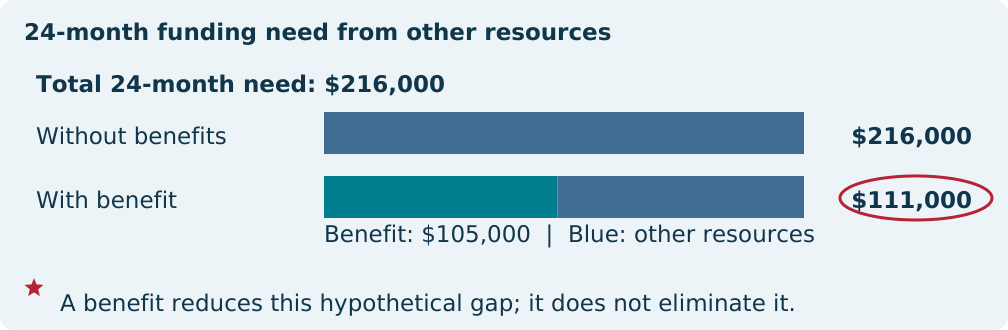
The $105,000 of hypothetical care benefits shown in this report reduces care-period funding needs. It is not $105,000 of net savings from buying a policy: premiums and the opportunity cost of committed capital are excluded. A fair ownership comparison must separately show premium payments, remaining accessible assets, surrender value and any remaining death benefit under actual contract terms.
| Contract question | Why the cash-flow answer changes |
|---|---|
| Reimbursement or indemnity? | Reimbursement generally depends on eligible expenses, subject to limits. Indemnity or cash benefits follow the policy’s payment conditions; terms vary. |
| Calendar days or service days? | A waiting period counted only on qualifying service days can last longer than the same number of calendar days. |
| Monthly cap and total pool? | A monthly benefit may leave a gap even before the total benefit pool is exhausted. |
| Care paid, what remains? | Accelerating life-insurance benefits for care can reduce remaining death benefits. Surrender rights and any return-of-premium terms must be checked separately. |
These are contract-review questions, not a quotation of any specific product. No benefit, premium or policy-value forecast is supplied without a verified illustration.
A CLOSER LOOK
Test the care bill and the household budget together
Care planning becomes more concrete when the continuing household expenses stay in the calculation. In this hypothetical two-year scenario, the household still needs $6,000 a month for ordinary expenses, after adjusting for costs that care would replace. Qualifying care adds another $8,000 a month. Reliable spendable income remains $5,000 a month. These figures are invented for planning, not local care-cost estimates.
★ Even in the version with benefits, this household still needs $9,000 a month from other resources for the first three months and $4,000 a month for the next 21. The funding plan must cover both periods. Then test a longer care need, rising costs or lower household income. A benefit limit should be evaluated alongside the remaining spouse's needs, not in isolation.
The coordination gap
Consider a hypothetical couple who know their policy's monthly benefit but have never discussed its claim requirements. One spouse assumes benefits begin with the first care bill. The advisor assumes a relative can cover the waiting period, but the relative works full time. Reviewing the actual policy, family availability and cash needs together reveals the gap while there is time to plan for it.
Questions worth bringing to your professionals
- What ordinary household expenses continue, and which costs would care replace?
- How much accessible money covers any waiting period and expenses above the benefit?
- Could household or business income fall when care begins?
- Who can manage a claim, pay bills and make legally authorized decisions if needed?
- What changes if care lasts longer, costs rise or both spouses need help?
This is an invented cash-flow example, not a policy quotation or a recommendation to buy or replace coverage. It assumes eligible care, sufficient total policy benefits, unchanged income and costs, and a simplified three-calendar-month period without benefits. Actual eligibility, elimination-period counting, payment method and limits vary by contract. Premiums, taxes, investment returns and inflation are excluded. Review an actual policy and care plan with qualified professionals.
What a thoughtful review could help you do
- See the combined household and care budget, not just the care bill.
- Compare legal planning, self-funding and insurance trade-offs before a crisis.
- Protect decision-making time for both spouses and the people who may help them.
A practical next step
Start with a family conversation and a realistic care budget. Review legal and insurance alternatives with qualified professionals while choices are still available; eligibility and rules vary.
These are planning opportunities, not promised outcomes.