Your Portfolio Has a Tax Bill. Who Is Managing It?

START WITH YOUR LIFE, NOT A PRODUCT
The return you keep deserves its own review.
An owner celebrates a strong business year, sells an appreciated investment, and later learns that a fund also distributed taxable gains. Meanwhile, losses in another account went unreviewed. This fictional story is not a market failure; it is a coordination problem.
Tax-aware management looks across gains, losses, tax lots, account activity and the broader plan throughout the year. The objective is not a trophy for the largest reported loss. It is to evaluate after-tax outcomes while keeping an appropriate investment exposure.
Think of tax lots as receipts in a well-run inventory system. Knowing what was bought, when and at what cost can change which shares are sensible to sell. But a loss can lose its usefulness if another account triggers a wash sale or the replacement investment changes the risk.
You watch what your investments earn. But how much do you keep?
If you own mutual funds in a taxable account, you can owe tax on a fund’s capital-gains distribution even when you never sold a share. Reinvesting the distribution does not erase that tax. A fund can also distribute gains during a year when its share price falls. That makes taxes part of the investment conversation, not just an April appointment with your accountant. Vanguard explains fund distributions.
How much gets passed through?
There is no single average that describes every mutual fund. Invesco, using Morningstar data, reports a 5%–8% range of average annual capital-gains distributions across U.S. equity style-box mutual funds over 2016–2025, measured as a percentage of net asset value. That is a category range, not a prediction for your funds and not a tax rate. Invesco’s analysis and methodology.
For illustration, a $100,000 holding with a 6% distribution passes through $6,000. If that entire amount is long-term gain taxed at 15%, the federal tax would be $900, before other applicable taxes or offsets. A distribution is not free extra return: the fund’s price adjusts for the payout.
Work the plan before December
A thoughtful, year-round process can include:
- Choose the right tax lots. Purchases made on different dates have different costs and holding periods. Properly identifying the shares sold can help control realized gains or harvest available losses. Discuss with your broker how share identification, confirmation and any existing average-cost election affect the choices available.
- Swap carefully. Selling a losing investment and buying a suitable replacement can preserve market exposure, but the replacement must not be substantially identical for wash-sale purposes. A different ticker alone is not a guarantee.
- Respect the whole wash-sale window. The rule generally covers purchases 30 days before and after a loss sale. Waiting until day 31 afterward does not cure an earlier replacement purchase. Review automatic reinvestments, other accounts, a spouse’s purchases and IRAs. An IRA replacement can permanently disallow the loss rather than simply defer it.
IRS Publication 550: identification, basis and wash sales.
Review opportunities during the year and across tax years, alongside rebalancing, cash needs and expected distributions. Losses available in spring may disappear by December. But don’t take unnecessary investment risk or trade just to manufacture a deduction.
Why direct indexing changes the conversation
A mutual fund gives you shares in a pooled portfolio. You cannot personally sell one losing stock inside it. The fund uses its losses internally; it does not pass those losses through for you to use against unrelated gains.
Direct indexing puts individual stocks in your own account to seek index-like exposure. That creates more individual tax lots and potential loss-harvesting opportunities, even when the overall market rises. It also adds fees, trading complexity and possible differences from the index. A low-cost, tax-efficient ETF may be the better fit for some investors. Natixis on direct indexing and tax management.
What “tax alpha” actually means
Tax alpha measures the improvement in performance relative to a benchmark attributable to tax management: after-tax excess return minus pretax excess return. It can come from using losses against gains, deferring gains and managing holding periods. It is not a promised bonus return.
AIA means Active Index Advisors, the direct-indexing capabilities within Natixis Investment Managers Solutions. Its September 30, 2026 factsheet reports 2.75 percentage points of annualized ten-year net tax alpha using maximum federal tax rates and zero state tax. The same table shows a 13.70% net after-tax strategy return versus 14.29% for its modeled after-tax benchmark. Positive tax alpha did not mean overall outperformance after fees.
Those historical calculations assume losses offset gains when incurred and apply a 3% model bundled annual fee. They are not a forecast, a mutual-fund comparison, or a measure of your tax savings. AIA S&P 500 strategy factsheet, pages 2 and 5.
Start with what you already own
An appreciated mutual fund may carry a substantial tax cost to sell. A transition deserves its own analysis. Tax-loss harvesting often defers tax by lowering the replacement investment’s basis; it does not necessarily eliminate the bill. Its value depends on usable gains, tax rates, future sales and costs. It does not create current deductible investment losses inside an IRA.
After capital-gain offsets, net capital losses can generally offset up to $3,000 of ordinary income annually ($1,500 if married filing separately), with unused losses carried forward. IRS capital-gain and loss rules.
Bring your holdings, cost basis and questions. Ask: What am I paying in distributions? Who watches my tax lots? Would a gradual, coordinated change improve what I keep? Review the answer with your financial advisor and tax professional before trading.
Educational information, not individualized tax or investment advice. Investing involves loss risk. Past results do not guarantee future results; tax laws and individual circumstances can change.
Follow one sale through the tax lots
Suppose a taxable account owns two identifiable lots of the same stock. Both lots have been held more than one year. The investor needs $10,000 of proceeds, the share price is $100, and the broker permits and properly records specific-share identification. This invented example excludes fees, other taxes and wash sales.
| Sell 100 shares | Proceeds | Basis | Realized gain |
|---|---|---|---|
| Lot A: $40 basis per share | $10,000 | $4,000 | $6,000 |
| Lot B: $90 basis per share | $10,000 | $9,000 | $1,000 |
Same cash raised, $5,000 less gain realized now. At an assumed 15% federal long-term capital-gains rate, the current tax is $900 versus $150: a $750 difference. The lower-basis shares remain, so their embedded gain has not disappeared. Account elections and identification deadlines can affect which lots may be sold.
Restore the workbook’s own $4,000 example
The source workbook’s page 17 uses a separate illustration: $20,000 of eligible capital losses × an assumed 20% rate on gains they offset = $4,000 of current tax deferred or reduced. This is not $4,000 of portfolio performance. It assumes the losses can offset those gains and survive wash-sale checks. Additional management costs and future taxes can reduce or eliminate the benefit.
The wash-sale window has two sides
| Days −30 through −1 | Day 0 | Days +1 through +30 |
|---|---|---|
| Look backward for substantially identical purchases. | Loss sale occurs. | Look forward for substantially identical purchases. |
Day 31 afterward is not a complete rule. A purchase before the sale may already matter. Review automatic dividend reinvestments, spouse activity, IRAs and outside accounts. A taxable-account wash sale generally defers the disallowed loss through replacement basis; an IRA purchase can produce permanent disallowance. The rule concerns substantially identical securities, not simply matching ticker symbols.
Read tax alpha as a difference of differences
Using the AIA factsheet figures already discussed: net after-tax strategy return 13.70% minus after-tax benchmark 14.29% equals −0.59 percentage point of after-tax excess return. Reported tax alpha of +2.75 percentage points therefore implies pretax excess return of −3.34 points under that same definition: −0.59 − (−3.34) = +2.75. Figures are rounded and annualized; this is a reconciliation of the stated metric, not a new performance estimate.
Circle the distinction: positive tax alpha and negative overall after-tax excess return can coexist. Tax management is one component of an outcome, not proof that an investor finished ahead. The factsheet’s tax-rate, fee and loss-utilization assumptions remain essential.
Source context: original workbook p. 17, IRS Publication 550 and linked AIA factsheet in this article. The lot-sale example is additional hypothetical arithmetic, not a tax-lot recommendation.
Why a harvested loss can reappear later
New hypothetical example: shares bought for $100,000 are sold for $80,000, realizing a $20,000 eligible loss. A suitable, non-substantially-identical replacement is purchased for $80,000. If it is later sold for $110,000, its gain is $30,000. Had the original $100,000-basis investment instead been retained and eventually sold for the same $110,000, that gain would have been $10,000.
| Illustration | Current loss | Later gain |
|---|---|---|
| Harvest and replace | −$20,000 | $30,000 |
| Retain original | None realized | $10,000 |
The $20,000 difference in later gains equals the earlier loss. At a constant assumed 20% tax rate with fully usable offsets, $4,000 less tax now can mean $4,000 more later. Timing may have value, but changed tax rates, fees, tracking differences and later disposition matter. Equal later values are an assumption, not a forecast that different investments perform identically.
A CLOSER LOOK
Make the tax coordination visible
A tax loss is useful only in the context of a whole tax return and investment plan. The question is not how many trades a manager made. It is whether the investor kept an appropriate exposure while improving the timing or amount of tax actually paid.
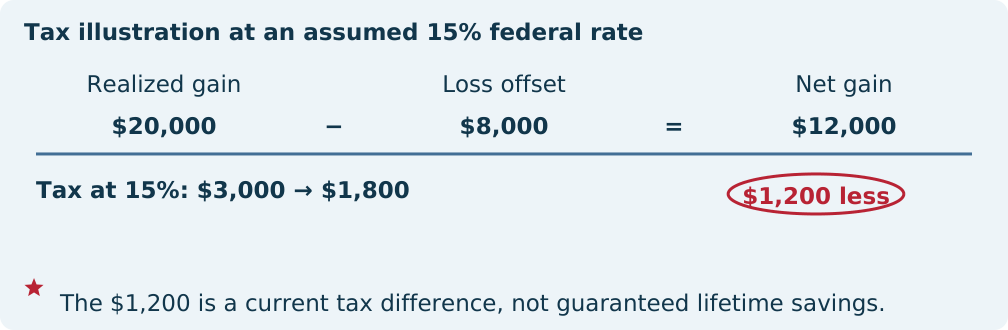
★ Star the word current: $8,000 × 15% = $1,200 less current federal tax in this simplified example. Lower replacement basis can create a larger taxable gain later. A loss is not an $8,000 tax credit.
The coordination gap
A portfolio manager harvests a loss while another account automatically buys the same security. The intended deduction may be deferred or disallowed. The investment manager, tax professional and household need a coordinated view of accounts and reinvestments.
Questions worth bringing to your professionals
- Who tracks tax lots and confirms the shares sold?
- Who checks the 30 days before and after a loss sale?
- Is the likely benefit still meaningful after fees and transition taxes?
Assumes losses are usable against the gains shown and no wash sale, state tax or other adjustment. Tax alpha is a measure with assumptions, not guaranteed outperformance or a forecast of personal tax savings.
What a thoughtful review could help you do
- Make tax-lot selection part of the decision, not an afterthought.
- Identify coordination needs across taxable, retirement and spouse accounts.
- Evaluate whether a tax benefit survives fees, trading costs and future taxes.
A practical next step
Bring account activity and realized-gain information to your advisor and tax professional before major trades. Ask how replacement purchases, reinvested dividends and other accounts are checked.
These are planning opportunities, not promised outcomes.